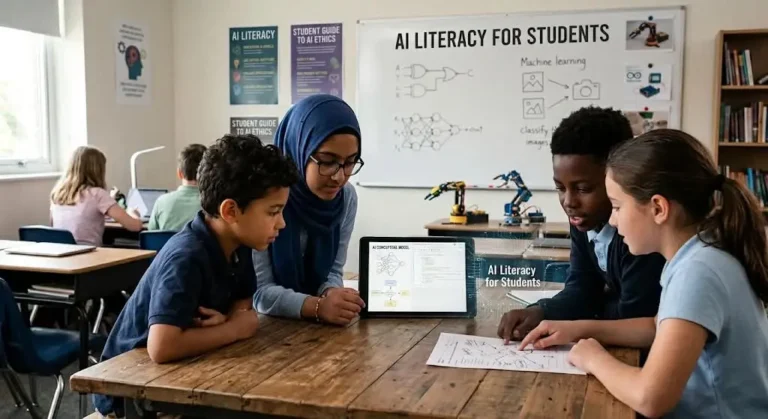
Artificial intelligence is changing the way people study, work, communicate, and solve everyday problems. From personalized online lessons to intelligent research assistants, AI is creating new opportunities for people who want to learn faster, develop practical skills, and prepare for future careers. AI learning is no longer limited to computer science students or technology professionals. School students, university learners, teachers, business owners, freelancers, and working professionals can all benefit from understanding artificial intelligence.
However, learning AI involves much more than knowing how to use a chatbot. It requires understanding how intelligent systems work, recognizing their limitations, evaluating their outputs, and applying them responsibly to real-world problems. Whether you are a complete beginner or someone looking to develop advanced technical knowledge, this article explains how to learn artificial intelligence for beginners, including essential skills, learning methods, useful tools, career opportunities, and the future of artificial intelligence.

What Is AI Learning
AI learning has two closely related meanings.
First, it refers to the process of learning about artificial intelligence, including its technologies, concepts, applications, and practical uses. People develop AI-related knowledge and skills so they can work with intelligent systems and understand their impact on society.
Second, AI learning can refer to using artificial intelligence to improve the learning process itself. AI-powered educational systems can help students understand difficult subjects, practice new skills, receive feedback, and study according to their individual needs.
For example, a student learning mathematics can use an AI-powered assistant to understand a complicated equation step by step. Similarly, someone interested in programming can use AI to explain unfamiliar code, identify errors, and suggest practice exercises.
How Does Artificial Intelligence Work
Artificial intelligence is a field of computer science focused on developing systems that can perform tasks commonly associated with human intelligence. These tasks include recognizing patterns, understanding language, making predictions, processing information, and generating content.
AI systems rely on different technologies, depending on their purpose. Here are some important concepts that beginners should understand:
Machine Learning
Machine learning is a branch of AI that allows computer systems to identify patterns in data and improve their performance through experience. Instead of relying entirely on manually written instructions, machine learning models learn statistical relationships from examples.
For instance, an email filtering system can learn to distinguish between unwanted messages and legitimate communication by analyzing patterns in previously classified emails.
Deep Learning
Deep learning is a specialized area of machine learning that uses multi-layered artificial neural networks to process complex information. It plays an important role in technologies such as image recognition, speech processing, language understanding, and autonomous systems. Deep learning is particularly useful when a task involves large amounts of complex data.
Natural Language Processing (NLP)
Natural Language Processing enables computers to analyze, interpret, and generate human language. It supports applications such as translation software, voice assistants, automated customer support, and AI writing tools. For example, a language-learning application may use NLP to identify grammatical mistakes and suggest more natural expressions.
Generative Artificial Intelligence
Generative AI refers to systems capable of producing new content based on patterns learned during training. Depending on the model, generated content may include:
- Written articles and explanations.
- Computer programming code.
- Images and illustrations.
- Audio and speech.
- Video and other multimedia content.
Why Is AI Learning Important
Understanding artificial intelligence is becoming an important part of modern digital literacy. AI-powered technologies are influencing education, healthcare, business, communication, scientific research, and many other industries.
People who understand how these systems work are better prepared to evaluate AI-generated information, identify potential risks, and use technology more effectively. There are several reasons why learning AI matters today.
Growing Demand for AI-Related Skills
Organizations across different industries are exploring AI to improve productivity, analyze information, automate repetitive activities, and develop new services. This creates opportunities for individuals who understand AI concepts and can apply them to practical problems.
However, learning AI does not guarantee employment. Employers also consider professional experience, communication skills, technical ability, and practical project work.
Better Learning Experiences
AI-powered educational tools can provide explanations, practice questions, and feedback based on individual learning needs. Students can revisit difficult topics, explore alternative explanations, and practice at their own pace.
Improved Productivity
AI can help people organize information, summarize documents, generate ideas, and assist with routine tasks. Used appropriately, these capabilities can save time and allow individuals to concentrate on activities requiring human judgment and creativity.
Preparation for Future Technologies
As AI becomes more integrated into everyday digital services, understanding its basic principles will help people adapt to technological changes. AI literacy is therefore valuable even for people who do not plan to become AI engineers or data scientists.
Benefits of AI Learning for Students and Professionals
Learning about artificial intelligence can provide benefits at different stages of education and professional development.
| Benefit | How It Helps |
| Personalized learning | Supports learning activities based on individual needs |
| Better problem-solving | Encourages analytical thinking and experimentation |
| Productivity | Helps organize information and reduce repetitive work |
| Technical development | Builds knowledge of modern digital technologies |
| Creativity | Supports brainstorming and exploring new ideas |
| Research assistance | Helps organize and investigate information |
| Career preparation | Develops skills relevant to AI-related industries |
| Digital literacy | Improves understanding of technology and its limitations |
How to learn artificial intelligence for beginners
You do not need to be an experienced programmer to begin learning artificial intelligence. A beginner can start with fundamental concepts and gradually move toward more technical subjects. The following learning path provides a practical starting point.
Step 1: Understand the Fundamentals of AI
Begin by learning what artificial intelligence is, how it differs from traditional software, and where it is used. Focus on basic concepts such as:
- Artificial intelligence.
- Machine learning.
- Deep learning.
- Neural networks.
- Generative AI.
- Natural Language Processing.
- Computer vision.
Step 2: Develop Basic Mathematical Knowledge
Mathematics is important for understanding how many AI models operate. For technical AI development, useful mathematical subjects include:
- Algebra.
- Probability.
- Statistics.
- Linear algebra.
- Calculus.
Beginners do not need to master every mathematical topic before exploring AI applications. However, a stronger mathematical foundation becomes increasingly important when studying machine learning algorithms and developing models.
Step 3: Learn Python Programming
Python is one of the most widely used programming languages in artificial intelligence and data science. Its relatively readable syntax and extensive collection of libraries make it suitable for beginners and experienced developers. Some useful Python libraries include:
- NumPy for numerical computing.
- Pandas for data manipulation.
- Matplotlib for data visualization.
- Scikit-learn for traditional machine learning.
- PyTorch for deep learning.
- TensorFlow for machine learning and deep learning applications.
Step 4: Explore Machine Learning
After understanding Python fundamentals, begin studying machine learning. Learn about important techniques such as:
- Supervised learning.
- Unsupervised learning.
- Classification.
- Regression.
- Clustering.
- Model evaluation.
Step 5: Practice with Real Projects
Practical experience is essential for developing useful AI skills. You can begin with manageable projects such as:
- Building a simple spam email classifier.
- Creating a basic movie recommendation system.
- Developing a chatbot for frequently asked questions.
- Analyzing a small dataset.
- Creating a simple image classification model.
Step 6: Learn Responsible AI Usage
Technical knowledge alone is not enough. You should also understand data privacy, fairness, bias, copyright considerations, misinformation, and the limitations of AI-generated content.
Best AI Learning Tools and Platforms
Several educational platforms and AI-powered tools can help beginners explore artificial intelligence. Some offer free learning resources, while others provide paid courses or additional features. Here are some useful options.
Google Machine Learning Education
Google provides educational resources that introduce machine learning concepts, practical techniques, and responsible AI development. Its Machine Learning Crash Course is particularly useful for learners who want to understand fundamental machine learning concepts through lessons and exercises.
Microsoft Learn
Microsoft Learn offers structured educational materials covering artificial intelligence, machine learning, Azure AI services, and related technologies. It is useful for students, developers, and professionals interested in building practical technology skills.
Coursera
Coursera provides online courses and professional learning programs from universities and educational organizations. Learners can explore introductory AI subjects, machine learning, data science, and specialized technical programs. Course access, certificates, and pricing depend on the individual program.
edX
edX offers online educational programs covering computer science, artificial intelligence, mathematics, and other academic subjects. It can be a useful choice for learners who prefer structured lessons and university-level educational content.
Kaggle
Kaggle is a popular platform for practicing data science and machine learning. It provides datasets, coding notebooks, competitions, and educational materials. Beginners can use its resources to develop practical experience without immediately building an entire AI system from scratch.
ChatGPT
ChatGPT can support AI learning by explaining technical concepts, generating practice questions, reviewing code, and helping learners understand difficult topics. For example, beginners can ask it to explain machine learning using simple examples before exploring the mathematical details.
However, AI-generated explanations should be checked against reliable educational materials, especially when learning technical or factual subjects.
AI Learning for Students
Artificial intelligence can support students at different educational levels, from primary education to university studies. Instead of replacing traditional learning methods, AI can provide additional explanations and learning opportunities.
School Students
School students can use suitable AI-powered educational resources to understand mathematics, science, languages, and other subjects. Teachers can also introduce age-appropriate activities that help students understand how AI works and why responsible technology use matters.
College Students
College students can explore AI fundamentals, programming, data analysis, and subject-specific applications. For example, business students may study AI applications in marketing, while science students may explore machine learning in research.
University Students
University learners can develop more advanced knowledge through research projects, programming assignments, machine learning experiments, and interdisciplinary studies. AI can also support academic research when students independently verify information, follow institutional policies, and acknowledge permitted assistance.
AI Learning for Teachers and Educators
Teachers have an important role in helping students understand artificial intelligence. AI tools can assist educators with lesson planning, generating practice questions, preparing learning materials, and providing additional explanations.
For example, a teacher may use an AI assistant to create different versions of a mathematics exercise for students with different levels of understanding. However, teachers should review AI-generated materials before using them in classrooms.
Educational decisions require professional judgment, knowledge of students’ needs, and an understanding of the curriculum. UNESCO’s AI Competency Framework for Teachers identifies five important areas: human-centered thinking, AI ethics, AI foundations and applications, AI pedagogy, and AI for professional learning. This framework provides a useful foundation for developing responsible AI skills among educators.
AI Learning and Career Opportunities
Artificial intelligence knowledge can support career development in several technology-related and non-technical professions. Some careers require advanced programming and mathematical knowledge, while others focus on applying AI tools to existing professional activities. The following table highlights some potential career paths.
| Career | Main Responsibilities |
| AI Engineer | Develops and integrates AI-powered applications |
| Machine Learning Engineer | Builds and maintains machine learning systems |
| Data Scientist | Analyzes data and develops predictive models |
| Data Analyst | Interprets information to support decisions |
| NLP Engineer | Works with language-processing technologies |
| Computer Vision Engineer | Develops systems for image and video analysis |
| AI Researcher | Studies and develops new AI methods |
| AI Product Manager | Coordinates AI product development and strategy |
| AI Automation Specialist | Designs workflows using AI and automation tools |
The qualifications for these positions vary considerably. Some require degrees in computer science, mathematics, or related fields, while others may accept relevant technical training and demonstrated project experience.
Can You Learn AI Without Coding
Yes. You can develop useful AI literacy and learn to work with AI-powered tools without knowing how to program. For example, you can explore:
- Generative AI applications.
- AI-assisted research.
- Prompt design and evaluation.
- No-code automation.
- AI-supported content workflows.
- Responsible AI practices.
Challenges and Risks of AI Learning
Although artificial intelligence offers many educational opportunities, it also introduces challenges that learners should understand.
Incorrect or Misleading Information
AI systems can generate convincing answers that contain factual errors. This is particularly important when studying scientific subjects, historical events, medical information, or technical topics.
Overdependence on AI
Relying on AI to complete every assignment can weaken independent thinking and problem-solving abilities. Students should attempt to understand a problem before asking an AI system to solve it.
Data Privacy
Some AI services process information that users enter into their systems.
Bias and Fairness
AI models may reproduce biases present in their training data or development processes. This can influence recommendations, predictions, and generated information.
Unequal Access to Technology
Not everyone has reliable internet access, suitable devices, or opportunities to receive quality digital education. This digital divide can prevent some learners from benefiting equally from AI-related developments.
Academic Integrity
Submitting AI-generated assignments as entirely independent work may violate institutional rules. Students should follow their schools’ and universities’ policies regarding AI assistance, citations, and original academic work.
What Is the Future of AI Learning?
The future of AI learning will likely involve a closer relationship between human education and intelligent technology. AI-powered educational platforms may become increasingly capable of adapting explanations, practice activities, and feedback to individual learning needs.
However, the most effective educational approach will not simply involve giving students access to more powerful AI systems. Learners will still need foundational knowledge, independent reasoning, communication skills, creativity, and the ability to evaluate information.
The OECD’s Digital Education Outlook 2026 highlights an important distinction: using generative AI to produce a better assignment does not automatically mean that a student has learned more. The report emphasizes purposeful educational use, human judgment, foundational skills, and teaching strategies that preserve students’ active involvement in learning.
Similarly, the OECD and European Union’s 2026 AI literacy framework emphasizes that AI literacy involves more than simply interacting with AI tools. Learners should understand, evaluate, create with, manage, and responsibly engage with AI.
These developments suggest that future education will need to teach people both how to use artificial intelligence and how to think independently in an AI-supported environment.
Frequently Asked Questions About AI Learning(FAQ)
- What is AI learning in simple words?
AI learning means developing knowledge and skills related to artificial intelligence. It can also describe the use of AI-powered technologies to support education, practice, and personalized learning.
- Can beginners learn AI without technical knowledge?
Yes. Beginners can start by understanding basic AI concepts and exploring accessible AI applications. Programming and mathematics can be introduced gradually as they move toward technical AI development.
- How long does it take to learn AI?
The learning period depends on your goals. Basic AI literacy may take a few weeks of consistent study, while developing professional machine learning or AI engineering skills generally requires considerably more time and practical experience.
- Is Python necessary for learning artificial intelligence?
Python is not necessary for understanding AI concepts or using many AI-powered applications. However, it is highly useful for machine learning, data science, and AI development.
- Can students use AI for studying?
Yes. Students can use appropriate AI tools to explore difficult topics, practice questions, receive explanations, and organize study materials. They should verify information and follow academic integrity guidelines.
Read more
- AI Literacy for Students: Importance, Benefits, Essential Skills
- Study Abroad in UK: Cost, Requirements, Scholarships & Complete Guide
- Top 10 best university in USA for international students
- top 10 best universities in Europe for international students
- Study Abroad in Canada: Requirements, Costs, Scholarships & Guide
- Study in Australia: Admission, Cost, Requirements & Scholarships
- Periods of English Literature chart
- Figure of Speech
- Hamlet Summary by William Shakespeare: Plot and soliloquy Analysis
- Study Abroad in Japan: Complete Guide for International Students
- Commonwealth Shared Scholarships: Eligibility, Benefits, Application Process
- Top 10 Countries for International Students, Costs, Universities, Scholarships