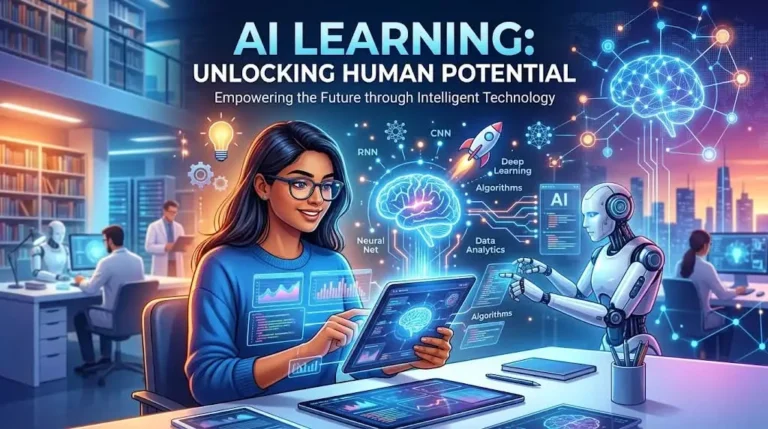
Artificial intelligence is becoming an important part of modern education. Students can now use AI-powered applications to explore difficult subjects, practice new skills, organize information, and develop creative projects. However, having access to these technologies does not automatically mean that students know how to use them effectively.
AI literacy helps students understand how artificial intelligence works, recognize its limitations, evaluate the information it produces, and make responsible decisions when using AI-powered tools. It also encourages young people to become thoughtful creators of technology rather than passive users.
As artificial intelligence continues to influence education, employment, communication, and everyday life, students need more than traditional digital skills. They must learn how to interact with intelligent systems while protecting their privacy, maintaining independent thinking, and understanding the ethical consequences of their decisions. In this article, we explore what AI literacy means for students, why it matters, which skills they should develop, how schools can teach it, and how learners can prepare for an increasingly AI-driven world.
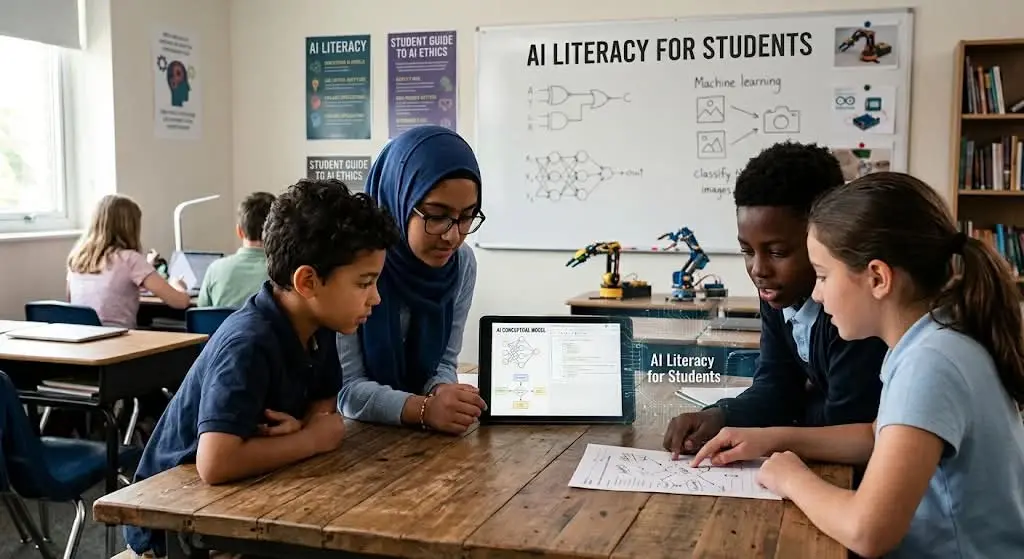
What Is AI Literacy for Students
AI literacy for students refers to the knowledge, practical abilities, and responsible attitudes required to understand, evaluate, and interact with artificial intelligence. It involves learning how AI systems operate, identifying situations where AI is being used, recognizing possible errors, and deciding when these technologies are appropriate for educational or personal purposes.
For example, a student may use an AI assistant to understand a complicated scientific concept. An AI-literate student will not automatically accept every explanation as correct. Instead, they will compare important information with textbooks, academic resources, or reliable educational websites. AI literacy also involves understanding that artificial intelligence is developed by people, trained using data, and influenced by the decisions made during its design and deployment.
It is not limited to programming or advanced computer science. Students can begin developing AI literacy without knowing how to write code. The broader goal is to prepare young people to understand, use, question, and responsibly shape AI technologies.
Why Is AI Literacy Important for Students
Artificial intelligence is increasingly influencing how information is produced, shared, and evaluated. Students who understand these technologies can make more informed decisions about their education and future careers. Here are some important reasons why AI literacy deserves attention in modern education.
Preparing Students for a Changing Job Market
Many industries are exploring artificial intelligence to improve their operations, analyze information, and develop new products and services. As a result, familiarity with AI technologies can become useful across different professional fields.
For example, business students may encounter AI-assisted market research, engineering students may work with intelligent design systems, and healthcare students may study AI-supported diagnostic technologies.
Improving Digital and Information Literacy
The internet contains enormous amounts of information, but not everything published online is accurate. Generative AI can produce answers that appear convincing even when some details are incorrect or unsupported.
Students with AI literacy understand the importance of checking sources, comparing evidence, and questioning information before using it in assignments or research. These habits strengthen their ability to navigate the modern digital environment.
Encouraging Independent Thinking
AI tools can explain difficult concepts and suggest possible solutions, but students still need to develop their own understanding. For example, instead of asking an AI assistant to complete an entire mathematics assignment, a student can request an explanation of a particular formula and then solve similar problems independently. This approach makes AI a learning companion rather than a substitute for intellectual effort.
Supporting Personalized Education
Different students have different learning speeds, interests, and educational needs. AI-powered learning applications can offer alternative explanations, additional exercises, and feedback based on individual performance. A student struggling with grammar, for instance, may use an AI-supported language tool to identify mistakes and practice sentence construction. Such assistance can complement classroom teaching when it is used appropriately.
Promoting Responsible Technology Use
AI systems introduce questions about privacy, fairness, misinformation, copyright, and accountability. Students need to understand these issues before relying heavily on AI applications.
Developing responsible habits early can help young people protect their personal information and recognize the possible consequences of inappropriate AI use.
Essential AI Literacy Skills Every Student Should Develop
AI literacy involves several connected abilities. Students should gradually develop these skills through classroom activities, independent study, and practical experience.
Understanding Basic AI Concepts
Students should understand the basic meaning of artificial intelligence and become familiar with related technologies. Important concepts include
- Artificial Intelligence (AI)
- Machine Learning (ML)
- Deep Learning
- Neural Networks
- Natural Language Processing (NLP)
- Generative AI
- Computer Vision
They do not need to study every technical detail immediately. A basic understanding of these subjects can help them recognize how different AI applications operate.
Effective AI Tool Usage
Knowing how to communicate with AI systems is a practical skill. Students should learn how to provide clear instructions, explain their objectives, include relevant context, and ask follow-up questions when an answer is incomplete.
For example, instead of asking an AI assistant to explain science generally, a student could request a beginner-friendly explanation of photosynthesis with a simple example. They should also understand that clearer instructions do not guarantee accurate answers.
Critical Evaluation of AI-Generated Information
This is one of the most important aspects of AI literacy. AI-generated content may contain outdated facts, fabricated references, mathematical mistakes, or misleading explanations. Students should develop the habit of asking
- Is this information factually correct?
- Can I identify reliable supporting sources?
- Does the explanation match what I have learned?
- Is important information missing?
- Could the response contain bias?
Data Privacy and Security Awareness
Students should understand that information entered into an AI service may be processed according to that service’s data-handling policies. They should avoid sharing sensitive personal details, passwords, private school records, financial information, or confidential documents.
Before using an unfamiliar AI application, students should consider its privacy settings, age requirements, and terms of service.
Understanding AI Ethics
AI ethics concerns the principles that guide the responsible development and use of artificial intelligence. Students should explore issues such as:
- Fairness and discrimination.
- Privacy and consent.
- Copyright and ownership.
- Transparency and accountability.
- Misinformation and manipulation.
- Environmental effects of technology.
These discussions help students understand that technological progress should also consider human rights and social responsibilities.
Creative Problem-Solving
AI can help students explore different approaches to a problem. For example, a student working on a school science project may use AI to brainstorm possible experiments, organize research questions, or explore alternative explanations.
The student should still decide which ideas are practical, scientifically appropriate, and supported by evidence.
Basic Knowledge of How AI Systems Work
AI literacy becomes stronger when students understand that intelligent systems are built using data, algorithms, and computational models. Students can begin with simple demonstrations of pattern recognition and classification.
More advanced learners can explore how training data, model evaluation, and machine learning algorithms influence an AI system’s behavior.
Benefits of AI Literacy for Students
Developing AI literacy can support students in several areas of academic and personal development.
| Area | Potential Benefits |
| Academic learning | Provides additional explanations and learning resources |
| Research skills | Encourages source verification and information evaluation |
| Digital literacy | Improves understanding of modern technologies |
| Critical thinking | Helps students question automated answers |
| Creativity | Supports brainstorming and project development |
| Problem-solving | Introduces new ways to explore complex problems |
| Career preparation | Builds awareness of AI-related workplace skills |
| Responsible behavior | Encourages ethical and safer technology use |
Best AI Tools Students Can Use for Learning
Several AI-powered applications can support different educational activities. The most suitable tool depends on a student’s age, learning objectives, school policies, and available resources. Here are some widely used options.
- ChatGPT
ChatGPT can help students explore unfamiliar topics, understand complicated explanations, generate practice questions, and receive assistance with programming concepts. For example, a student learning biology can request a simple explanation of how the human respiratory system works. Students should verify factual answers and avoid using generated responses as unquestioned academic evidence.
- Google Gemini
Google Gemini is an AI assistant that can help users explore topics, generate ideas, summarize information, and work with supported content. Students may use it to explore academic questions and develop a better understanding of unfamiliar subjects. As with other AI assistants, its answers should be checked before being used in important academic work.
- Microsoft Copilot
Microsoft Copilot provides AI-assisted capabilities for information exploration, writing support, and productivity. Depending on the available version and account, students may use it to organize ideas, explore subjects, and assist with educational tasks.
- Khan Academy and Khanmigo
Khan Academy provides educational resources across multiple subjects, including mathematics, science, and humanities. Its AI-supported learning experience, Khanmigo, is designed to support teaching and learning through guided educational assistance. Availability, pricing, and access conditions vary by location and account type.
- Quizlet
Quizlet provides digital study resources, including flashcards, practice activities, and learning tools. Students can use it to review vocabulary, revise important concepts, and prepare for examinations. Some AI-powered features depend on the subscription and availability.
- Grammarly
Grammarly offers writing assistance that can help students identify grammar, spelling, and clarity issues. It may be useful for improving written communication, although students should ensure that the final work reflects their own understanding and follows academic rules.
Important: Students should check the minimum age requirements, school policies, regional availability, and privacy conditions before registering for any AI service. Not every tool is appropriate for every age group.
How Students Can Develop AI Literacy
AI literacy does not have to begin with advanced computer science lessons. Students can start with everyday activities and gradually develop a deeper understanding of artificial intelligence. The following steps provide a practical learning approach.
Step 1: Explore Everyday AI Applications
Start by identifying where artificial intelligence appears in daily life.
Examples include:
- Search engine recommendations.
- Voice recognition systems.
- Translation applications.
- Online shopping recommendations.
- Navigation services.
- AI-powered chatbots.
Step 2: Learn How AI Produces Answers
Students should explore how AI systems use information and computational models to generate responses. They can compare answers from different AI applications and investigate why the results may differ.
A useful exercise is to ask two AI assistants the same educational question and check their explanations against a trusted textbook.
Step 3: Practice Writing Clear Instructions
Students can experiment with different ways of asking questions. For example, they can compare a broad instruction with a more specific one that identifies the subject, educational level, and expected explanation.
They should observe how the responses change and whether the additional context improves usefulness.
Step 4: Verify Important Information
Every student should learn how to confirm important AI-generated claims.
Useful verification methods include:
- Consulting textbooks.
- Reading official educational materials.
- Checking university or government websites.
- Comparing information from multiple reliable sources.
- Looking for original research when appropriate.
Step 5: Complete Small AI-Related Projects
Practical activities make AI concepts easier to understand. Students can try projects such as
- Creating a simple AI-assisted study guide.
- Comparing machine-generated and human-written explanations.
- Investigating how recommendation systems work.
- Exploring basic image classification.
- Developing a simple educational chatbot with suitable supervision.
Step 6: Reflect on Responsible AI Use
After completing an AI-assisted activity, students should consider whether the tool genuinely helped them understand the subject. They should also reflect on privacy, accuracy, originality, and whether they relied too heavily on automated assistance.
AI Literacy in Schools: What Should Teachers Do
Schools play an important role in preparing students to understand and use artificial intelligence responsibly. AI literacy should not be treated as a subject that only computer science students need to study. Its principles can be introduced through different academic disciplines.
For example, science teachers can demonstrate how AI supports research, language teachers can discuss AI translation, and social science teachers can explore algorithmic bias and the social impact of automation.
Teachers can also introduce classroom activities that encourage students to evaluate AI-generated information instead of accepting it automatically. Important educational approaches include
- Introducing age-appropriate AI concepts.
- Teaching students how to verify information.
- Discussing privacy and digital safety.
- Encouraging independent problem-solving.
- Establishing clear rules for AI-assisted assignments.
- Using practical examples from different subjects.
- Helping students understand the limitations of AI tools.
UNESCO’s AI Competency Framework for Students
UNESCO published its AI Competency Framework for Students in 2024 to help education systems prepare young people for responsible participation in an AI-influenced world. The framework identifies 12 competencies across four important dimensions.
Human-Centred Mindset
Students should understand the importance of human agency, human rights, and human responsibility when interacting with artificial intelligence.
Ethics of AI
Learners should recognize ethical challenges involving fairness, privacy, accountability, and responsible technology use.
AI Techniques and Applications
Students should develop foundational knowledge of AI technologies and understand how they are applied in different situations.
AI System Design
Learners should explore how AI systems are developed and consider how they can contribute to designing more inclusive and responsible technologies. UNESCO organizes these competencies around three progression levels: Understand, Apply, and Create.
This approach encourages students to move beyond simply operating AI tools toward understanding and contributing to the development of AI technologies.
The 2026 OECD and European Commission AI Literacy Framework
An important development in 2026 was the publication of Empowering Learners for the Age of AI: An AI Literacy Framework for Primary and Secondary Education. The framework was jointly developed by the OECD and European Commission and published on June 18, 2026.
It provides a common reference for teaching AI literacy to primary and secondary school learners. The framework organizes AI literacy into four broad areas:
| Competency Area | What Students Should Learn |
| Engage with AI | Recognize AI systems and evaluate their outputs |
| Create with AI | Collaborate with AI to develop and improve content |
| Manage AI | Decide when and how AI should be used |
| Shape AI | Understand and influence the development of AI systems |
The framework also identifies 19 competencies involving knowledge, skills, and attitudes. One important message is that AI literacy should not be reduced to learning how to write better prompts. Students must also understand AI’s role in society, evaluate its results, make informed decisions, and participate responsibly in an AI-supported world.
Challenges Students Face When Learning AI
Although AI literacy offers valuable educational opportunities, students may encounter several difficulties during the learning process.
- Lack of Reliable Learning Resources
Some students may struggle to identify accurate educational materials, particularly when AI-related information changes quickly. Teachers and educational institutions can help by recommending reliable learning resources and teaching students how to evaluate sources.
- Overdependence on AI Tools
Students may become overly dependent on automated assistance when completing assignments or solving problems. This can reduce opportunities to practice independent reasoning. A better approach is to use AI for explanations, feedback, and additional practice while completing essential learning activities independently.
- Limited Digital Access
Not all students have reliable internet connections, modern devices, or access to suitable educational platforms. This creates differences in opportunities to develop AI-related skills. Schools and education policymakers should consider accessibility when introducing AI learning programmes.
- Misinformation and AI Errors
Generative AI can produce incorrect explanations and fabricated references. Students who lack verification skills may unknowingly use inaccurate information in their academic work. Teaching source evaluation should therefore be an essential part of AI literacy.
- Privacy and Online Safety
Some AI services collect or process user information. Students need age-appropriate guidance on account security, data sharing, consent, and online privacy.
- Unequal Understanding of AI
Students may have different levels of experience with digital technologies. An effective AI literacy programme should accommodate different learning abilities rather than assume that every student starts with the same knowledge.
The Future of AI Literacy in Education
The importance of AI literacy is likely to increase as intelligent technologies become more integrated into education and everyday activities. Future students may interact with AI-powered learning assistants, adaptive educational platforms, automated feedback systems, and advanced research tools more frequently.
However, technological access alone will not guarantee meaningful learning. Students will continue to need strong reading, writing, mathematics, communication, and analytical abilities. These foundational skills help learners evaluate AI-generated information and understand subjects independently.
Educational institutions will also need to address questions about academic integrity, student privacy, equal access, and the appropriate role of automated systems in classrooms. The OECD and European Commission’s 2026 framework reflects this broader direction by treating AI literacy as a combination of knowledge, practical skills, and responsible attitudes.
Frequently Asked Questions About AI Literacy for Students (FAQ)
- What does AI literacy mean for students?
AI literacy means developing the knowledge and skills needed to understand, evaluate, and use artificial intelligence responsibly. It includes recognizing AI-generated content, checking information, protecting privacy, and understanding ethical issues.
- Why should students learn AI literacy?
Students should learn AI literacy because artificial intelligence is influencing education, communication, research, and employment. Understanding AI helps them use technology more effectively while recognizing its risks and limitations.
- At what age should students start learning AI literacy?
Students can begin learning age-appropriate AI concepts during their school years. Younger learners can explore simple examples of AI, while older students can study machine learning, data, AI ethics, and more advanced applications.
- Do students need coding skills to become AI literate?
No. Basic AI literacy does not require programming knowledge. Students can learn how AI works, evaluate its outputs, and use suitable AI tools without writing code. Programming becomes important for learners interested in developing AI systems.
- What are the most important AI literacy skills?
Important skills include understanding AI concepts, using AI tools effectively, evaluating generated information, protecting personal data, recognizing bias, understanding AI ethics, and solving problems independently.
Read more
- Study Abroad in UK: Cost, Requirements, Scholarships & Complete Guide
- Top 10 best university in USA for international students
- top 10 best universities in Europe for international students
- Study Abroad in Canada: Requirements, Costs, Scholarships & Guide
- Study in Australia: Admission, Cost, Requirements & Scholarships
- Periods of English Literature chart
- Figure of Speech
- Hamlet Summary by William Shakespeare: Plot and soliloquy Analysis
- Study Abroad in Japan: Complete Guide for International Students
- Commonwealth Shared Scholarships: Eligibility, Benefits, Application Process
- Top 10 Countries for International Students, Costs, Universities, Scholarships
- How to learn artificial intelligence for beginners, Complete Guide to AI, Its Benefits, Skills, and Future