Choosing the right scientific calculator can make mathematics and science courses easier, faster, and more manageable. Whether you are a high school student, a college learner, or an engineering student, having a reliable calculator can help you solve equations, work with fractions, perform statistical calculations, and handle advanced mathematical problems.

However, finding the right model is not always easy. Some calculators are designed for basic classroom calculations, while others offer advanced features for calculus, physics, statistics, and engineering.
If you are searching for the best scientific calculator in USA, this guide compares 10 popular models from Casio and Texas Instruments. We will explore their important features, advantages, limitations, and ideal users to help you make an informed buying decision.
Best scientific calculator in USA
1. Casio fx-991CW ClassWiz

The Casio fx-991CW ClassWiz is an excellent option for students who want a versatile scientific calculator with modern features.
It offers a high-resolution Natural Textbook Display and a wide range of mathematical applications. Students can use it for statistics, equations, matrices, vectors, and several advanced calculations.
Key Features:
- More than 540 mathematical functions
- High-resolution Natural Textbook Display
- Solar and battery power
- Matrix and vector calculations
- Complex number calculations
- Equation and inequality solving
- Statistical and regression functions
- Numerical differentiation and integration
- Spreadsheet functionality
Advantages: Its modern display, extensive mathematical tools, and solar-assisted power make it suitable for demanding academic work.
Limitations: The menu-based interface may take time to learn, and it cannot display graphs directly on its own screen.
Our Verdict: A strong all-round choice for high school and college students who need advanced mathematical functions without purchasing a graphing calculator.
Best for: College students, physics, statistics, and engineering.
2. Texas Instruments TI-36X Pro

The TI-36X Pro is designed for students who regularly work with complex mathematical and scientific problems.
Its four-line MultiView display allows users to review multiple calculations. It also includes dedicated equation solvers, matrix operations, and vector calculations.
Key Features:
- Four-line display
- Numeric equation solver
- Polynomial equation solver
- System of linear equations solver
- Matrix and vector calculations
- Numerical differentiation and integration
- One-variable and two-variable statistics
- Fraction and decimal conversion
- Solar-assisted battery power
Advantages: Its equation-solving tools and advanced mathematical functions make it particularly useful for college-level STEM subjects.
Limitations: Beginners may find its advanced functions unnecessary for basic mathematics.
Our Verdict: One of the strongest choices for engineering, physics, calculus, and college mathematics, especially when graphing calculators are not permitted.
Best for: Engineering, computer science, physics, and advanced mathematics.
3. Casio fx-115ES PLUS 2nd Edition

The Casio fx-115ES PLUS 2nd Edition is another capable scientific calculator for students who need more than basic mathematical functions.
It supports 252 mathematical functions and offers a Natural Textbook Display that presents mathematical expressions in a familiar format.
Key Features:
- 252 mathematical functions
- Natural Textbook Display
- Matrix and vector calculations
- Complex number mode
- Numerical integration and differentiation
- Equation and inequality calculations
- Statistical functions
- 40 scientific constants
- Metric conversions
Advantages: It combines advanced mathematical capabilities with a relatively straightforward design. Its functions are useful for calculus, physics, and engineering coursework.
Limitations: Its interface is less modern than the newer fx-991CW.
Our Verdict: A practical option for students who want advanced functions without paying for a graphing calculator.
Best for: Calculus, algebra, physics, and engineering students.
4. Texas Instruments TI-30XS MultiView

The TI-30XS MultiView is designed to make classroom mathematics easier to understand. Its four-line display allows students to view multiple calculations instead of relying on a single-line interface.
Key Features:
- Four-line MultiView display
- MathPrint textbook-style display
- Fraction calculations
- Fraction and decimal conversion
- One-variable and two-variable statistics
- Trigonometric functions
- Solar and battery power
Advantages: Its readable display and fraction capabilities make it helpful for students learning algebra, geometry, and introductory statistics.
Limitations: It does not offer the same advanced equation-solving and matrix functionality as the TI-36X Pro.
Our Verdict: A dependable choice for high school students who want a simple but capable scientific calculator.
Best for: Algebra, geometry, statistics, and general science.
5. Casio fx-570ES PLUS 2nd Edition
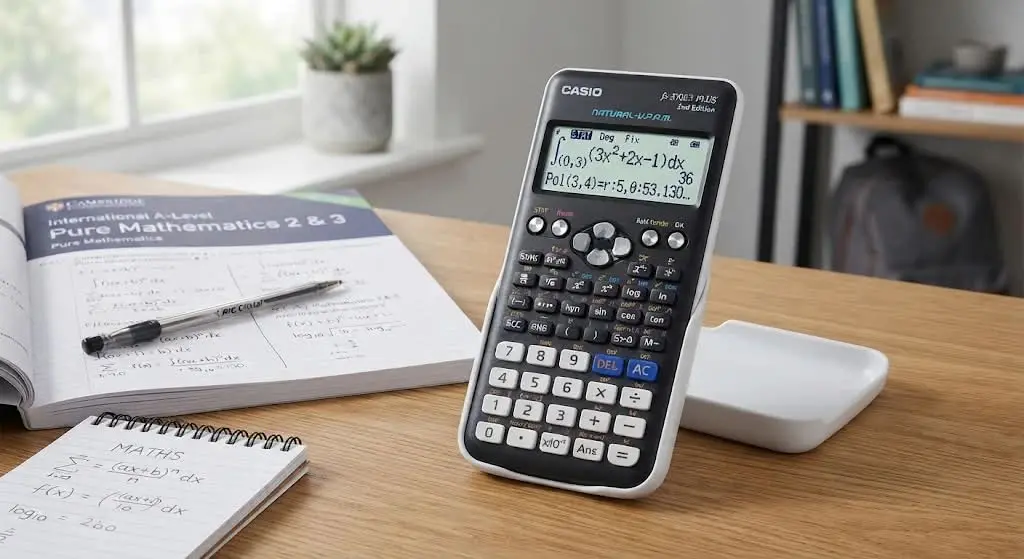
The Casio fx-570ES PLUS 2nd Edition is a versatile scientific calculator with a broad range of mathematical functions.
It offers Natural Textbook Display and supports several advanced calculations, making it useful for students studying mathematics and science.
Key Features:
- 417 mathematical functions
- Natural Textbook Display
- Matrix and vector calculations
- Complex number calculations
- Numerical integration and differentiation
- Equation solving
- Statistical calculations
- Scientific constants and metric conversions
Advantages: Its advanced functions make it suitable for students who frequently solve complicated mathematical problems.
Limitations: It uses a traditional interface, so beginners may need time to become familiar with its functions.
Our Verdict: A good option for students who want a traditional scientific calculator with extensive mathematical capabilities.
Best for: College mathematics, calculus, physics, and engineering.
6. Casio fx-300ES PLUS 2nd Edition
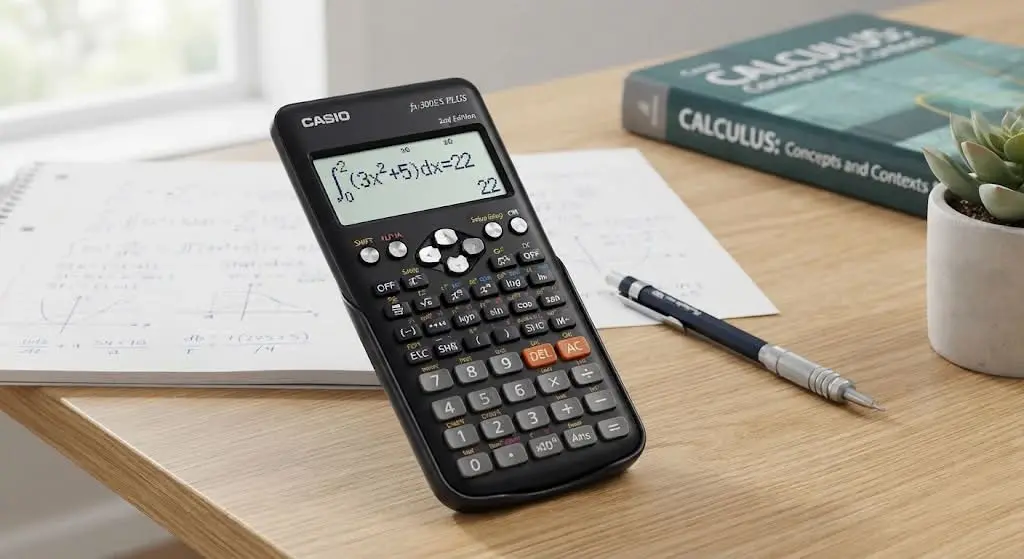
Students who do not need highly advanced functions may find the Casio fx-300ES PLUS 2nd Edition a practical choice.
It provides essential scientific calculations in a straightforward design. Its Natural Textbook Display makes mathematical expressions easier to read.
Key Features:
- Natural Textbook Display
- Fraction calculations
- Trigonometric functions
- Statistical calculations
- Prime factorization
- Random number generation
- Solar and battery power
- Protective hard case
Advantages: It covers many common school mathematics requirements without making the interface unnecessarily complicated.
Limitations: It lacks some of the advanced features found in Casio’s higher-end models, including matrix and vector calculations.
Our Verdict: A sensible choice for students who need reliable everyday scientific calculations.
Best for: Middle school, high school, algebra, and general mathematics.
7. Texas Instruments TI-34 MultiView

The TI-34 MultiView is designed to support students learning mathematical concepts through an easy-to-read display and practical functions.
Its four-line screen and MathPrint mode help students understand how expressions are structured.
Key Features:
- Four-line display
- MathPrint functionality
- Fraction calculations
- Scientific notation
- Statistical functions
- Trigonometric calculations
- Multiple calculation history
Advantages: Its display makes it easier to review calculations and understand mathematical expressions.
Limitations: It does not offer the advanced engineering and calculus tools available in higher-end models.
Our Verdict: A useful educational calculator for students who want a straightforward interface and practical mathematical tools.
Best for: Middle school, high school, and introductory mathematics.
8. Texas Instruments TI-30XIIS

The TI-30XIIS is a fundamental scientific calculator that combines everyday mathematical functions with useful scientific features.
Its two-line display shows the entered expression and the calculated result, helping students review their work.
Key Features:
- Two-line display
- Fraction calculations
- Trigonometric functions
- Logarithms and exponential functions
- One-variable and two-variable statistics
- Scientific and engineering notation
- Solar and battery power
Advantages: It is relatively straightforward to operate and offers useful functions for common mathematics and science courses.
Limitations: Its two-line display is less spacious than the four-line displays available on some competing models.
Our Verdict: A practical option for students who prefer a traditional calculator with essential scientific functions.
Best for: General mathematics, algebra, geometry, and introductory science.
9. Casio fx-260 SOLAR II
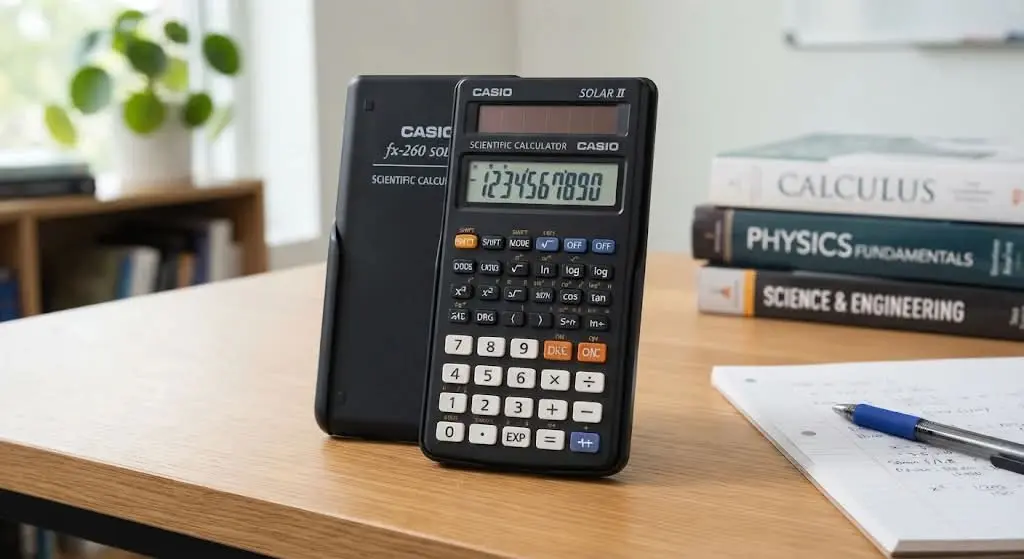
The Casio fx-260 SOLAR II is a compact scientific calculator designed for students who want a lightweight device for everyday calculations.
It uses solar power and offers several useful mathematical functions in a simple design.
Key Features:
- Compact and lightweight design
- 144 mathematical functions
- Solar-powered operation
- Two-line display
- Fraction calculations
- Trigonometric functions
- Logarithmic and exponential calculations
- Protective hard case
Advantages: Its compact design makes it convenient to carry in a school bag or pencil case. Solar power is another useful feature.
Limitations: It does not offer the advanced display and equation-solving tools found in more sophisticated scientific calculators.
Our Verdict: A good option for students who prioritize portability and basic scientific functionality.
Best for: Everyday calculations, schoolwork, and students who prefer a compact design.
10. Texas Instruments TI-30Xa

The TI-30Xa is a simple scientific calculator designed for general mathematics and introductory science calculations.
It focuses on essential functions rather than advanced mathematical applications.
Key Features:
- One-line display
- Scientific notation
- Trigonometric functions
- Logarithmic functions
- Fraction-to-decimal conversion
- Basic statistical functions
- General scientific calculations
Advantages: Its straightforward design makes it suitable for users who do not need complicated menus or advanced mathematical tools.
Limitations: Its single-line display and limited advanced functionality make it less suitable for demanding college mathematics and engineering coursework.
Our Verdict: A basic option for students who need essential scientific functions and prefer a traditional calculator.
Best for: Introductory mathematics and general scientific calculations.
How to Choose the Best Scientific Calculator in the USA
Before buying a scientific calculator, consider these important factors:
- Academic Requirements: Choose a calculator according to your subjects. Engineering and calculus students may need matrix, vector, and equation-solving functions.
- Display Quality: A multi-line or Natural Textbook Display can make complicated expressions easier to understand.
- Battery and Solar Power: Solar-assisted models can provide additional convenience during regular classroom use.
- Examination Compatibility: Check the official calculator rules for the SAT, ACT, AP, or other examinations before purchasing.
- Price and Value: Compare features and current prices rather than automatically choosing the most expensive model.
Comparison: Top 10 Scientific Calculators
| Calculator | Best For |
| Casio fx-991CW | Best overall |
| Texas Instruments TI-36X Pro | Engineering students |
| Casio fx-115ES PLUS 2nd Edition | Advanced mathematics |
| TI-30XS MultiView | High school students |
| Casio fx-570ES PLUS 2nd Edition | College mathematics |
| Casio fx-300ES PLUS 2nd Edition | Everyday school use |
| TI-34 MultiView | Middle and high school |
| TI-30XIIS | General mathematics |
| Casio fx-260 SOLAR II | Compact and simple use |
| TI-30Xa | Basic scientific calculations |
Which Scientific Calculator Should You Buy
Here is a simple recommendation based on different student needs:
- Best Overall: Casio fx-991CW
- Best for Engineering: Texas Instruments TI-36X Pro
- Best for Advanced Mathematics: Casio fx-115ES PLUS 2nd Edition
- Best for High School: TI-30XS MultiView
- Best for College: Casio fx-570ES PLUS 2nd Edition
- Best for Everyday School Use: Casio fx-300ES PLUS 2nd Edition
- Best for Beginners: TI-34 MultiView
- Best for General Mathematics: TI-30XIIS
- Best Compact Option: Casio fx-260 SOLAR II
- Best for Basic Calculations: TI-30Xa
Final Thoughts
Choosing the best scientific calculator depends on your educational level, mathematical requirements, and budget. A high school student may need only essential scientific functions, while an engineering student may require advanced tools for matrices, vectors, and calculus.
Among these 10 options, the Casio fx-991CW stands out as a versatile all-round choice, while the TI-36X Pro is particularly attractive for advanced STEM coursework. For students who prefer simplicity, the TI-30XS MultiView and Casio fx-300ES PLUS 2nd Edition are worth considering.
Frequently Asked Questions (FAQs)
- What is the best scientific calculator in the USA?
The Casio fx-991CW is a strong all-round choice because of its extensive mathematical functions, high-resolution display, and solar-plus-battery power.
- Which scientific calculator is best for engineering students?
The Texas Instruments TI-36X Pro is an excellent option because it supports matrix calculations, vectors, equation solving, and numerical calculus operations.
- Is Casio better than Texas Instruments?
Both brands offer reliable scientific calculators. Casio provides several models with Natural Textbook Display, while Texas Instruments offers useful MultiView displays and dedicated mathematical tools. The better choice depends on individual requirements.
- Can I use a scientific calculator in the SAT or ACT?
Several scientific calculators from Casio and Texas Instruments are permitted on these examinations. However, examination policies can change, so always check the official rules before test day.
- Do I need a graphing calculator for college?
Not necessarily. Many college mathematics and science courses can be completed with a scientific calculator. However, certain courses may require graphing capabilities.
Read more
- Study Abroad in UK: Cost, Requirements, Scholarships & Complete Guide
- Top 10 best university in USA for international students
- top 10 best universities in Europe for international students
- Study Abroad in Canada: Requirements, Costs, Scholarships & Guide
- Study in Australia: Admission, Cost, Requirements & Scholarships
- Hamlet Summary by William Shakespeare: Plot and soliloquy Analysis
- Study Abroad in Japan: Complete Guide for International Students
- Commonwealth Shared Scholarships: Eligibility, Benefits, Application Process
- Top 10 Countries for International Students, Costs, Universities, Scholarships
- How to learn artificial intelligence for beginners, Complete Guide to AI, Its Benefits, Skills, and Future
- AI Literacy for Students: Importance, Benefits, Essential Skills
- Best drawing pencils in US, Reviewed, Prices & Where to Buy