
Voice Change কি?
English Grammar-এ একটি গুরুত্বপূর্ণ বিষয় হলো Voice Change। এর মাধ্যমে আমরা Grammar কে সঠিকভাবে বুঝতে পারি। Grammar-এ এর গুরুত্ব অপরসীম। English Grammar-এর খুবই গুরুত্বপূর্ণ একটি বিষয় হচ্ছে Voice Change. Active ও Passive Structure গুলো খুব ভালোভাবে আয়ত্ত করা জরুরি Voice এর ক্ষেত্রে। পরীক্ষায় যে শুধুমাত্র Voice change আসে এমন না, এটা Right forms of verbs হিসেবে খুবই গুরুত্বপূর্ণ। আর Right form of verbs-এ verb টি Active না Passive হবে এই কৌশল জানা না থাকলে ভোগান্তি পেতে হয়। আর Passive voice সবসময় ‘by’ থাকে না, তাই গুলিয়ে ফেলার সম্ভাবনা রয়েছে। তাই ব্যতিক্রমী Voice Change Rules গুলো জানা আবশ্যক।
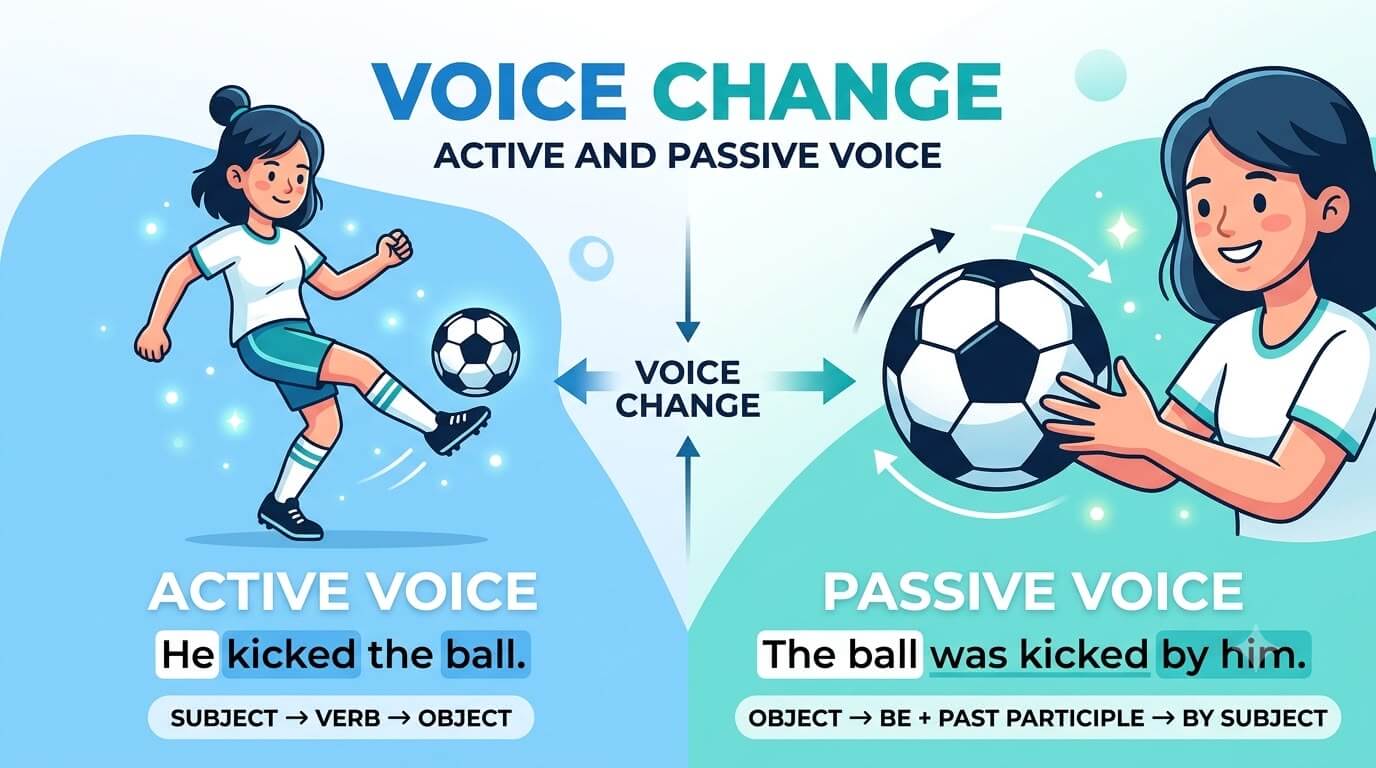

Voice কত প্রকার?
Voice প্রধানত ২ প্রকার
1. Active Voice: যে Sentence এ Subject নিজে সক্রিয় ভাবে কাজ করে তাকে Active voice বলে। যেমন: He is playing Tennis.
2. Passive voice: যে sentence এ subject নিজে কোনো কাজ করে না কিন্তু তার কাজ object দিয়ে করায় তাকে Passive voice বলে। যেমন: Tennis had been played by him.
Voice Change Basic structure and Tense
Rules নিয়ে আলোচনার আগে Active and Passive এর Basic Structure গুলো নিয়ে আলোচনা জরুরি। এগুলো অবশ্যই অবশ্যই আয়ত্তে থাকতে হবে।
1. Present Indefinite
Active Structure: Subject +Verb + Object
Example: He plays volleyball.
Passive Structure: Subject +am/is/are + Verb Past Participle +(by + Object)
Example: Volleyball is played by him.
2. Present Continuous
Active Structure: Subject +am/is/are + Verb + ing + Object
Example: He is playing volleyball.
Passive Structure: Subject +am/is/are + being + Verb Past Participle
Example: Volleyball is being played by him.
3. Present Perfect
Active Structure: Subject + have/has + Verb Past Participle + Object
Example: He has played volleyball.
Passive Structure: Subject + have/has + been + Verb Past Participle
Example: Volleyball has been played by him.
4. Past Indefinite
Active Structure: Subject + Past form of Verb + Object.
Example: He played volleyball.
Passive Structure: Subject + wase/were + Verb Past Participle
Example- volleyball was played by him.
5. Past Continuous
Active Structure: Subject + wase/were + V ing + Object.
Example: He was playing volleyball.
Passive Structure: Subject + wase/were + being + Verb Past Participle
Example: volleyball was being played by him.
6. Past Perfect
Active Structure: Subject + had + Verb Past Participle + Object.
Example: He had played volleyball.
Passive Structure: Subject + had + been + Verb Past Participle
Example: Volleyball had been played by him.
7. Future Indefinite
Active Structure: Subject + Shall/Will + Verb + Object.
Example: He will play volleyball.
Passive Structure: Subject + Shall/Will + be + Verb Past Participle.
Example: Volleyball will be played by him.
8. Future Continuous
Active Structure: Subject + Shall/Will + be + V-ing + Object
Example: He will be playing volleyball.
Passive Structure: Subject + Shall/Will + be + being + Verb Past Participle.
Example- Volleyball will be being played by him.
9. Future Perfect
Active Structure: Subject + Shall/Will +have + Verb Past Participle + Object.
Example: He will have played volleyball.
Passive Structure: Subject + Shall/Will + have+ been + Verb Past Participle.
Example: volleyball will have been played by him
Voice Change Rules
Voice Change Rules 1
Whom দিয়ে প্রশ্নবোধক বাক্য শুরু হলে এর Passive হবে:
Who +Auxiliary Verb (tense অনুযায়ী) + Verb Past Participle + by + Object.
Example:
- Active: Whom did Sohag invite?
- Passive: Who was invited by Sohag?
- Active: Whom are they helping?
- Passive: Who is being helped by them?
- Active: Whom were the police questioning?
- passive: Who was being questioned by the police?
Voice Change Rules 3
Who যুক্ত প্রশ্নবোধক বাক্যের Passive করার Structure:
By Whom + Auxiliary verb (tense অনুযায়ী) + Subject + Verb Past Participle
বি.দ্র: যদি বাক্যে দুটি Auxiliary থাকে তাহলে একটি Subject এর আগে বসবে, অপরটি পরে বসবে।
Example:
- Active: Who makes the building?
- Passive: By whom was the building made?
- Active: Who is helping the girl?
- Passive: By whom is the girl being helped?
Voice Change Rules 3
Modal Auxiliaries যেমন Can, Could, May, Might, Will, Would, Shall, Should, Ought to ইত্যাদি Passive করার সময় পরিবর্তন হয় না। এদের Passive Structure: Modal Auxiliary +be + Verb Past Participle
Example:
- Active: She can solve the math.
- passive: The math can be solved by her.
- Active: They may invite Habib.
- Passive: Habib may be invited by them.
.
- Active: You must finish dinner.
- Passive: The dinner must be finished by you.
Voice Change Rules 4
”Be going to” একটি Semi-Modal তাই Passive করার সময় Going এর কোনো পরিবর্তন হয় না। স্বাভাবিক নিয়মের সাথে ‘be’ এবং ‘to’-এর সাথে verb টির Past Participle করে Passive করতে হবে।
Example:
- Active: They are going to build a new house .
- Passive: A new house is going to be built by them.
- Active: She is going to complete the homework.
- Passive: The homework is going to be completed by her.
- Active: We are going to finish the work next month.
- Passive: The work is going to be finished next month by us.
Voice Change Rules 5
”Never” যুক্ত Imperative Sentence-এর Passive Structure:
Let not + Object + ever + be + Verb Past Participle.
Example:
- Active: Never break the rules.
- Passive: Let not the rules ever be broken.
- Active: Never waste time.
- passive: Let not time ever be wasted.
- Active: Never neglect your duties.
- Passive: Let not your duties ever be neglected.
- Active: Never insult the poor.
- Passive: Let not the poor ever be insulted.
Voice Change Rules 6
Phrasal verb যুক্ত Active বাক্যের Passive করার নিয়ম:
কোনো Active বাক্যের Verb যদি Phrasal verb হয় তাহলে Passive করার সময় Phrasal verb-এর সাথে যুক্ত Preposition verb-টির সাথেই বসবে।
Example:
- Active: Take care of your health
- Passive: Let your health be taken care of
Voice Change Rules 7
মূল Verb দ্বারা শুরু হওয়া Imperative Sentence এর Passive Structure:
Let + Object + be + Verb Past Participle.
Example:
- Active: Open the door
- Passive: Let the door be opened.
- Active: Write the letter.
- Passive: Let the letter be written.
Voice Change Rules 8
“Do not” যুক্ত Imperative Sentence-এর Passive করার Structure:
Let not + Object + be + Verb Past Participle.
Example:
- Active: Do not waste time.
- Passive: Let not time be wasted.
- Active: Do not tell a lie.
- passive: Let not a lie be told.
- Active: Do not break the rules.
- Passive: Let not the rules be broken.
Voice Change Rules 9
কিছু Verb আছে passive করার সময় তাদের পরে ‘by’ বসে না। ‘by’ এর পরিবর্তে অন্যান্য Preposition বসে।
এমন কিছু Verb হলো।
| Verb | Preposition |
|---|---|
| Know | to |
| Annoy | with |
| Surprise | at |
| Satisfy | with |
| Embody | in |
| Seize | with |
| Shock | at |
| Marvel | at |
| Contain | in |
Example:
- Active: People know him.
- Passive: He is known to everyone.
- Active: His behavior annoyed me.
- passive: I was annoyed with his behavior.
Voice Change Rules 10
Reflexive Object যুক্ত Active Voice কে Passive করার নিয়ম:
Active voice-এর Subject টি অপরিবর্তিত থাকবে + Tense অনুযায়ী Auxiliary verb + by+ Reflexive Object.
Example:
- Active: He killed himself.
- Passive: He was killed by himself.
- Active: She blamed herself.
- Passive: She was blamed by herself.
Read More
- Noun Classification সম্পর্কে জানতে পড়ুন
- Pronoun কত প্রকার জানতে পড়ুন
- Subject-Verb Agreement সহজ নিয়ম,ব্যবহার ও উদাহরণ
- Appropriate preposition
- Narration: এর সহজ নিয়ম, ব্যাখ্যা ও উদাহরণসহ বিস্তারিত আলোচনা
- Transformation of Sentence: কত প্রকার ও কি কি উদাহরণসহ
- Verb কত প্রকার ও কী কী? Best 15 টি সহজ নিয়ম ও উদাহরণ
- Number কি, কত প্রকার: best 20 টি Number চেনার সহজ উপায়
- Gender কত প্রকার ও কি কি? Best 10 টি চেনার সহজ নিয়ম
- Determiners কাকে বলে? কত প্রকার ও কী কী Best 10
- Degree কাকে বলে? কত প্রকার, Best 10টি Degreeপরিবর্তনের নিয়ম

Md Oliur Rahman Sohag বাংলা সাহিত্য, বাংলা ব্যাকরণ, কবি-সাহিত্যিক জীবনী এবং শিক্ষামূলক বিষয় নিয়ে লেখালেখি করেন। তিনি Study Journal X-এর প্রতিষ্ঠাতা ও প্রধান কনটেন্ট লেখক।