
Transformation of Sentence এর অর্থ হচ্ছে বাক্যের রূপান্তর বা বাক্যের রূপের পরিবর্তন। বাক্যের অর্থ বা ভাব ঠিক রেখে তার গঠন বা রূপ পরিবর্তন করার একটি ব্যাকরণগত প্রক্রিয়া। সহজ কথায়, একই কথা অন্য কোনো গ্রামার বা গঠনের সাহায্যে প্রকাশ করা, কিন্তু মূল অর্থের কোনো পরিবর্তন হবে না। আর Transformation of Sentence এ অর্থ ঠিক রেখে গঠন বা রূপ পরিবর্তন করার জন্য সুনির্দিষ্ট কিছু নিয়ম আছে। নিয়মগুলো নিয়ে বিস্তারিত আলোচনা করা হলো।
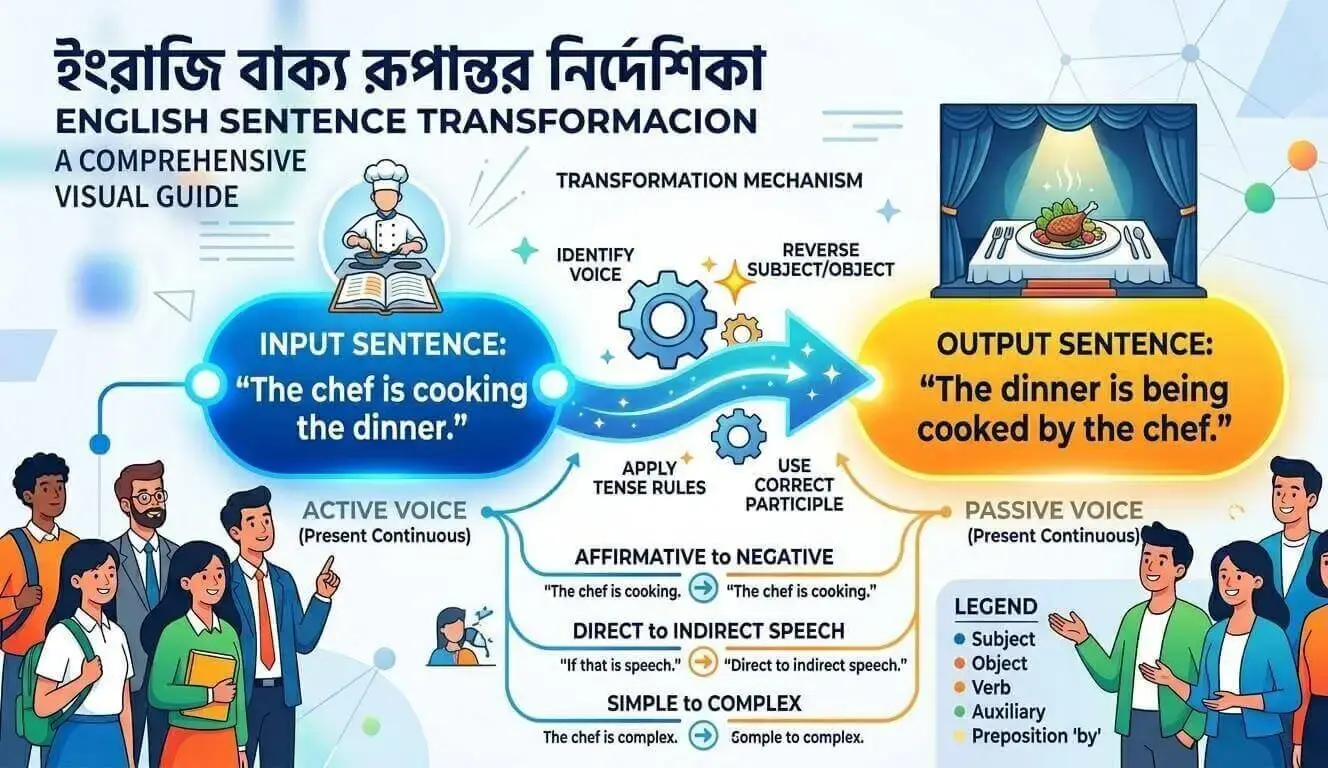
Why is sentence transformation important?
English grammar এ Transformation of sentence একটি গুরুত্বপূর্ণ টপিক। ইংরেজি ভাষায় এর ব্যবহার অপরিহার্য। ইংরেজি ভাষা শুদ্ধ ভাবে জানতে এর বিকল্প নেই। SSC, HSC, Admission, BCS সহ যে কোনো চাকরি পরীক্ষায় এ বিষয় থেকে প্রশ্ন আসে। তাই Transformation of Sentence একটি গুরুত্বপূর্ণ টপিক
Transformation of sentence rules with examples
AFFIRMATIVE TO NEGATIVE
Rule 1
Affirmative এ Always থাকলে, Negative এ Never হবে এবং বাক্যটির মূল অর্থ ঠিক রাখতে Main শব্দটার বিপরীত শব্দ বসবে।
Example:
- Affirmative: He is always polite.
- Negative: He is never rude.
- Affirmative: She always remembers my birthday.
- Negative: She never forgets my birthday.
- Affirmative: They are always honest.
- Negative: They are never dishonest.
Rule 2
Affirmative Sentence এ যদি Must থাকে তাহলে Negative করার সময় Must এর পরিবর্তে Cannot but অথবা Cannot help ব্যবহার করা হয়। তবে মনে রাখতে হবে, Cannot help বসালে তারপর অবশ্যই verb +ing (gerund) হবে।
Example:
- Affirmative: He must obey his parents.
- Negative: He cannot but obey his parents.
- Negative: He cannot help obeying his parents.
- Affirmative: I must tell the truth.
- Negative: I cannot but tell the truth.
- Negative: I cannot help telling the truth.
Rule 3
Only বা Alone যদি কোনো Affirmative Sentence থাকে তাহলে Negative Sentence এ Only বা Alone এর পরিবর্তে None but ও Nothing but বসে। Only বা Alone যদি ব্যক্তিবাচক Noun কে নির্দেশ করে সেক্ষেত্রে None but এবং যদি বস্তুবাচক Noun কে নির্দেশ করে তাহলে Nothing but বসে।
Example:
- Affirmative- Only Rahim was present.
- Negative : None but Rahim was present.
- Affirmative: Only the teacher knew the answer.
- Negative: None but the teacher knew the answer.
- Affirmative: Only my brother helped me.
- Negative: None but my brother helped me.
- Affirmative: He has only a pen.
- Negative: He has nothing but a pen.
- Affirmative: The box contains only books.
- Negative: The box contains nothing but books.
- Affirmative: She bought only clothes.
- Negative: She bought nothing but clothes.
Rule 4
Affirmative এ As soon as + Past Indefinite + Past Indefinite থাকলে Negative এ No sooner had+ Subject + Past Participle + Than+ Past Indefinite বসে।
Example:
- Affirmative: As soon as I reached the station, the train left.
- Negative: No sooner had I reached the station than the train left.
- Affirmative: As soon as the teacher entered the class, the students became silent.
- Negative: No sooner had the teacher entered the class than the students became silent.
Rule 5
Every দ্বারা যদি Affirmative Sentence টি শুরু হয় তাহলে Negative করার সময় Every এর পরিবর্তে There is no বসে। আবার Affirmative Sentence এ যদি Every এর পরে Noun+ have/has + noun থাকে তাহলে Negative করার সময় There is no এর পরে Noun+ Without + Noun বসে।
Example:
- Affirmative: Every country has a flag.
- Negative: There is no country without a flag.
- Affirmative: Every bird has wings.
- Negative: There is no bird without wings.
Rule 6
Affirmative Sentence টি Comparative degree তে থাকলে সেটি Negative করতে হলে Positive degree তে রূপান্তরিত করতে হয়।
Example:
- Affirmative: Gold is more precious than any other metal.
- Negative: No other metal is as precious as gold.
- Affirmative: Rahim is taller than any other boy in the class.
- Negative: No other boy in the class is as tall as Rahim.
- Affirmative: Mount Everest is higher than any other mountain in the world.
- Negative: No other mountain in the world is as high as Mount Everest.
Rule 7
Affirmative Sentence টি যদি Every + noun + transitive verb দ্বারা শুরু হয় তাহলে Negative করতে হলে Every এর পরিবর্তে there is no এবং Verb এর পূর্বে but/ who does not ব্যবহৃত হয়।
Example-
- Affirmative: Every student knows the answer.
- Negative: There is no student who does not know the answer.
- Affirmative: Every mother loves her child.
- Negative: There is no mother who does not love her child.
ASSERTIVE TO INTERROGATIVE
Rule 1
Be verb (am, is, are, was, were), Have verb (has, have, had), অথবা Modal verb (can, could, will, would, may, might, must, should ইত্যাদি) থাকলে এগুলোকে Subject-এর আগে এনে Interrogative করা হয়। আর যদি এগুলো না থেকে অন্য Main Verb থাকে, তাহলে Tense অনুযায়ী do/does /did Subject-এর আগে বসাতে হয়। Interrogative বাক্যে সাধারণত Not যোগ করা বাধ্যতামূলক নয়। not যোগ করলে সেটি Negative Interrogative হয়ে যায়। বাক্যের শেষে অবশ্যই (?) চিহ্ন ব্যবহার করতে হবে।
Example:
- Assertive: He is a student.
- Interrogative: Is he a student?
- Assertive: You play football.
- Interrogative: Do you play football?
- Assertive: She reads books.
- Interrogative: Does she read books?
Rule 2
Assertive Sentence এ All/Everyone /Everybody + Verb থাকে Interrogative করার সময় Who+ Auxiliary verb+ not+ verb ব্যবহার করতে হয়।
Example:
- Assertive: Everyone loves his country.
- Interrogative: Who does not love his country?
- Assertive: Everybody knows the truth.
- Interrogative: Who does not know the truth?
- Assertive: All like flowers.
- Interrogative: Who does not like flowers?
মনে রাখতে হবে, যদি মূল বাক্যে am/is/are/was/were থাকে, তাহলে সেই Auxiliary verb-ই ব্যবহার হবে।
Example:
- Assertive: Everyone is happy.
- Interrogative: Who is not happy?
যদি মূল বাক্যে সাধারণ Present বা Past tense থাকে, তাহলে do/does/did ব্যবহার করতে হবে।
- Assertive: Everybody helped the poor.
- Interrogative: Who did not help the poor?
Rule 3
Assertive Sentence এ No one/Nobody/None থাকে তাহলে Interrogative করার সময় এগুলোর পরিবর্তে Who ব্যবহৃত হয়।
Example:
- Assertive: No one can solve this problem.
- Interrogative: Who can solve this problem?
- Assertive: Nobody came to the meeting.
- Interrogative: Who came to the meeting?
EXCLAMATORY TO ASSERTIVE
Rule 1
How/What দিয়ে Exclamatory Sentence কে Assertive এ পরিবর্তে সময় Adjective এর পূর্বে very/ most এবং Noun থাকলে তার আগে Great বসে। Exclamatory Sentence এর Exclamation mark উঠে Assertive এ Full stop বসে।
Example:
- Exclamatory: How beautiful the flower is!
- Assertive: The flower is very beautiful.
- Exclamatory: What a great leader he is!
- Assertive: He is a very great leader.
Rule 2
Exclamatory Sentence যদি If, Would, Had, Were, Could, That ইত্যাদি দিয়ে শুরু হয় তাহলে Assertive Sentence এর প্রথমে I Wish ব্যবহৃত হয়।
Example:
- Exclamatory: If I were a king!
- Assertive: I wish I were a king.
- Exclamatory: Would that I could fly!
- Assertive: I wish I could fly.
SIMPLE, COMPLEX, COMPOUND
Rule 1
Compound Sentence এ and দ্বারা দুটি কাজ যুক্ত থাকলে Simple করার ক্ষেত্রে প্রথম কাজটির verb + ing হয়।
Example:
- Compound: He opened the door and entered the room.
- Simple: Opening the door, he entered the room.
- Compound: She took her bag and left the house.
- Simple: Taking her bag, she left the house.
Rule 2
Simple Sentence এ In spite of বা Despite থাকলে Complex Sentence রুপান্তরের সময় Though/ Although এবং Compound Sentence এ But ব্যবহৃত হয়।
Example:
- Simple: In spite of his poverty, he is honest.
- Complex: Although he is poor, he is honest.
- Compound: He is poor, but he is honest.
- Simple: In spite of the rain, they continued the match.
- Complex: Although it was raining, they continued the match.
- Compound: It was raining, but they continued the match.
Rule 3
Simple Sentence এ too+ adj+ to + verb থাকলে Negative অর্থ প্রকাশ করে এজন্য Complex করার সময় So that + Negative Clause এ পরিনত করতে হয়। Compound এ too বা so এর জায়গায় very এবং that এর জায়গায় And বসে।
Example:
- Simple: He is too weak to walk.
- Complex: He is so weak that he cannot walk.
- He is very weak, and he cannot walk.
- Simple: The box is too heavy to lift.
- Complex: The box is so heavy that nobody can lift it.
Rule 4
Simple Sentence টি Noun Phrase থাকলে Complex Sentence এ That/ WH Word যোগ করে Noun Clause এ পরিণত করতে হবে।
Example:
- Simple: I know his address.
- Complex: I know where he lives.
- Simple: He heard the news.
- Complex: He heard that he had passed the exam.
Read More
- Noun Classification সম্পর্কে জানতে পড়ুন
- Pronoun কত প্রকার জানতে পড়ুন
- Figure of speech সম্পর্কে জানতে পড়ুন
- Periods of English Literatureসম্পর্কে জানতে পড়ুন
- Subject-Verb Agreement সহজ নিয়ম,ব্যবহার ও উদাহরণ
- Appropriate preposition
- Voice change
- Narration: এর সহজ নিয়ম, ব্যাখ্যা ও উদাহরণসহ বিস্তারিত আলোচনা
- Verb কাকে বলে? কত প্রকার ও কী কী, Verb চেনার important নিয়ম
- Article কাকে বলে, কত প্রকার, Best 10 Important Article Rules

Md Oliur Rahman Sohag বাংলা সাহিত্য, বাংলা ব্যাকরণ, কবি-সাহিত্যিক জীবনী এবং শিক্ষামূলক বিষয় নিয়ে লেখালেখি করেন। তিনি Study Journal X-এর প্রতিষ্ঠাতা ও প্রধান কনটেন্ট লেখক।